Diastasis Recti Repair

In Ahmedabad · Dr. Jivraj Mehta Hospital, Vasna, Ahmedabad

You have a ridge or a dome down the middle of your tummy. It shows when you sit up from lying down, and it may have been there since a pregnancy. You may have been told it is a hernia. Most often it is not. It is a widening of the strip between your two stomach muscles, called diastasis recti. This page explains, honestly, what diastasis recti is, why physiotherapy comes first, when surgery truly helps, and which repair Dr Harsh Shah advises when it does.

In short: diastasis recti is not a true hernia and is not dangerous. Physiotherapy comes first. Surgery helps when a hernia sits in the gap or symptoms persist after proper exercise.

Dr Harsh Shah treats hernias and weakness of the tummy wall at Dr. Jivraj Mehta Hospital, Vasna, Ahmedabad. He trained in surgery at Maulana Azad Medical College, Delhi, and in surgical gastroenterology at GB Pant Hospital, Delhi. He has 18 years of experience. He repairs the midline both laparoscopically and by open surgery, and he will tell you plainly when exercise is a better answer than an operation.
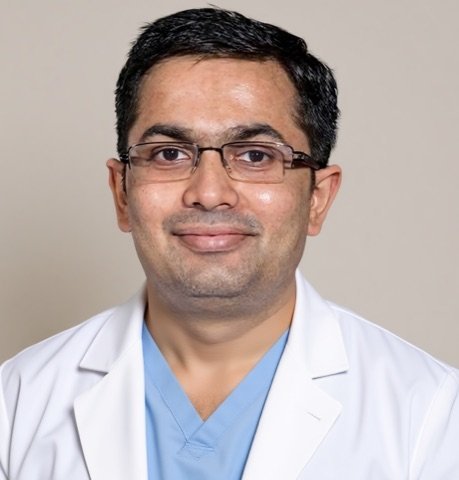
Last updated: 18 October 2026 · Written and medically reviewed by Dr Harsh Shah

Call +91 63555 64601 WhatsApp your scan or examination note

What diastasis recti is, and why it is not a true hernia

Diastasis recti is a widened, thinned midline between the two stomach muscles. There is no hole in it, so nothing can get trapped. That is why it is not a true hernia.

Your two long stomach muscles run from the ribs to the pubic bone. In the middle they are joined by a strip of tough tissue. In diastasis recti that strip stretches and thins, so the muscles drift apart. When you sit up, the soft middle bulges into a ridge.

A hernia is different. In a hernia there is a hole in the wall, with an edge. Fat or bowel can push through the hole and, now and then, get stuck. In diastasis the strip is thin but whole. There is no edge for anything to catch on. So a diastasis on its own does not cause a trapped bowel, and it is not an emergency.

The two can still occur together. A widened midline is often the ground in which a navel or an upper tummy hernia forms. That pairing is one of the main reasons surgery is considered at all. There is a fuller note on whether diastasis recti is a hernia.

Who gets it, and how it is measured

It is common after pregnancy and also occurs in men with weight around the waist. The gap between the muscles is measured by examination and ultrasound.

Pregnancy is the commonest cause. The growing womb stretches the midline, and almost every woman has some widening late in pregnancy. In many it closes partly or fully in the months after birth. Twins, more than one pregnancy and a large baby make it more likely to stay. Men get it too, most often with weight carried around the waist, and after big swings in weight.

Dr Harsh Shah asks you to lie on your back and lift your head. He feels the width of the gap above and below the navel, and checks for a true hernia along the line. An ultrasound measures the gap more exactly and shows any small hernia hiding in it. A width of more than about two centimetres is usually called diastasis. The width matters less than how your tummy works, and whether there is a hernia.

He also asks about back pain, leaking urine and how your core feels when you lift. These do not always come from the diastasis, so they are weighed with care before any operation is offered.

Physiotherapy comes first

For most people the first treatment is a guided core exercise program with a physiotherapist for several months. Many improve enough that they never need surgery.

The deep stomach muscle wraps around your waist like a corset. Training it, along with your breathing and pelvic floor, can narrow the gap and make your core work better. A physiotherapist who knows this condition teaches the right moves and stops the wrong ones. Hard sit-ups and heavy lifts with breath-holding can push the midline out, so they are changed early on.

The usual advice is to give this a fair trial of six to twelve months. After a pregnancy, the body also needs time to recover on its own. Most surgeons wait at least a year after the last birth before judging whether surgery is needed. Weight loss, where needed, helps as well. There is a note on exercise and yoga with a hernia that covers safe movement.

A binder or support belt can make you more comfortable in the early months after birth. It does not close the gap. See the note on abdominal binders.

When surgery truly helps

Surgery helps when a navel or upper tummy hernia sits in the widened midline, or when real symptoms remain after proper physiotherapy and your family is complete.

With an umbilical or epigastric hernia. This is the clearest reason. If the hernia is patched and the wide, weak midline around it is left alone, the repair is more likely to fail. So the gap is closed at the same time as the hernia is repaired. See the pages on umbilical hernia surgery and epigastric hernia surgery.

With symptoms that persist. Some people still have a bulge that aches, back pain linked to a weak core, or trouble with lifting after a full trial of physiotherapy. For them, closing the gap can help. The evidence here is less firm than for hernia repair. Dr Harsh Shah will say so, and talk through what is likely to change and what may not.

When the family is complete. A later pregnancy can stretch the midline again. Surgery is usually planned after the last planned birth.

When the main concern is loose skin. If the worry is mostly loose skin and stretch marks, the right operation is a tummy tuck by a plastic surgeon. The midline is tightened as part of it. Dr Harsh Shah will refer you if that is the better fit.

The repair options

The gap is closed by folding and stitching the midline, called plication. It can be done through small cuts with a camera, or through an open cut when loose skin is also removed.

OptionWhat is doneCutsWho it suitsMain drawback
PhysiotherapyGuided core and breathing exerciseNoneAlmost everyone, as the first stepNeeds months of regular effort
Endoscopic repair under the skinGap stitched from the front through small cuts low on the tummy, usually with a meshThree small cuts above the pubic areaDiastasis with a small navel or upper tummy hernia, little loose skinFluid under the skin is common for some weeks
Laparoscopic repair behind the muscleGap and any hernia closed from behind the muscle, mesh in that layerSmall cuts on the side of the tummyLarger hernias with diastasis, heavier patientsLonger operation, general anaesthetic
Open plicationGap stitched through an open cut, often with removal of loose skinOne long low cutMarked loose skin, often with a plastic surgeonLarger wound, longer recovery

Endoscopic repair under the skin. Through small cuts low on the tummy, a space is opened between the skin fat and the muscle sheath. The camera shows the whole midline. Any hernia is pushed back. The gap is then folded in and stitched from the breastbone to below the navel. A mesh is usually laid over the stitched line for support. This approach suits most people whose main problem is diastasis with a small hernia.

Laparoscopic repair behind the muscle. Here the space is opened behind the muscle instead. The gap and the hernia are closed and a mesh is laid in that layer. It suits larger hernias or heavier patients.

Open plication. When there is a lot of loose skin, the gap is stitched through a long low cut and the extra skin is removed. This is usually done with a plastic surgeon.

What patients say

Your patient journey: five steps

  1. Book your consultation. Call or send a WhatsApp message to book a visit. Bring any ultrasound report, the dates of your pregnancies and any past operation on your tummy, and notes from your physiotherapist if you have seen one.
  2. Tests and treatment plan. The gap is measured by examination and ultrasound, and any hernia is mapped. If you have not had a fair trial of physiotherapy, that is the plan first. If surgery is right, blood tests and a heart tracing are done, and the repair is explained.
  3. The surgery. The repair is done at Dr. Jivraj Mehta Hospital, Vasna, Ahmedabad, under general anaesthesia. It usually takes two to three hours.
  4. Short hospital stay. Most patients stay one or two nights. You walk the same evening. A thin drain may be left under the skin for a few days.
  5. Follow-up and full healing. You are seen at about one week and again at about six weeks. Desk work is usually possible within two to three weeks. Core exercise restarts with your physiotherapist from about six weeks.

The day of surgery, hour by hour

This is how a planned repair usually runs at Dr. Jivraj Mehta Hospital, Vasna, Ahmedabad. The times are a guide.

  1. Early morning. You arrive having had nothing to eat from midnight. Papers and insurance steps are completed. The anaesthetist sees you, and the gap and any hernia are marked while you stand.
  2. The operation. Under general anaesthesia. Local numbing medicine is put into the cuts so that you wake up more comfortable. A firm binder is put on before you wake.
  3. The same evening. You sit up, drink and eat a light meal, and walk with help.
  4. Going home, after one or two nights. The drain is checked and your pain is reviewed. You get tablets, binder advice, a list of warning signs, the date of your review and a phone number that is answered.

Cost, insurance and admission

The cost depends on the repair, whether a mesh is used, the stay and your health. Insurance cover depends on whether a hernia is present or the surgery is cosmetic.

No single figure fits everyone, so none is quoted here. These are the things that move the estimate. The length of the gap and the size of the mesh. Whether a hernia is repaired at the same time. The number of nights in hospital. Your other illnesses and the room category you choose.

Insurance is the part to check early. Repair of an umbilical or epigastric hernia, with closure of the gap, is covered by most policies. Diastasis repair done mainly for looks, or a tummy tuck, is usually not covered. Our coordinator sends the examination findings and scan report for pre-approval and tells you before admission what has been approved. Bring your insurance card, a photo ID, your policy papers and all your reports. There is a fuller note on hernia surgery and your insurance claim, and a page on what hernia surgery costs in Ahmedabad.

Recovery and what can go wrong

Expect tightness and soreness for two to three weeks and a binder for some weeks. Fluid under the skin is the most common problem, and it usually settles.

The usual course. Your tummy will feel tight, and getting out of bed hurts for the first days. Bruising is common. You wear a binder for some weeks, as advised. Walking starts on day one. Heavy lifting and hard core work wait until about six weeks.

Problems to know about. Fluid can collect under the skin, called a seroma. It is more common after repair under the skin. Most settle by themselves, and a few need a needle to drain them. Patches of numb skin on the tummy are common and usually fade over months. Wound infection, bleeding and mesh infection are uncommon.

The gap coming back. The midline can stretch again, most often after a later pregnancy or weight gain. Keeping a steady weight and keeping up your core exercise protect the repair. Read about hernia surgery recovery time and returning to work.

Questions patients ask

Is diastasis recti dangerous?

No. On its own it does not trap bowel and is not an emergency. A true hernia sitting in the gap is different, and that is checked at your visit.

Can exercise close the gap?

It can narrow it and, more importantly, make your core work better. Many people improve enough with a guided program that they do not need surgery.

How long after delivery should I wait before thinking of surgery?

Usually at least a year after the last birth, with physiotherapy during that time. The midline often improves on its own in the first months.

Can I get pregnant after the repair?

Yes, but a pregnancy can stretch the midline again. That is why surgery is usually planned after your family is complete. If a hernia needs repair sooner, this is discussed with you.

Will the repair flatten my stomach?

It firms the midline and removes the bulge from the gap. It does not remove fat or loose skin. If loose skin is the main concern, a tummy tuck by a plastic surgeon is the better fit.

Is a mesh used?

Often, yes. When the gap is stitched, a mesh laid over the line adds support, most of all when a hernia is also present. The mesh note explains the types.

Does diastasis happen after a caesarean?

Diastasis comes from the pregnancy, not the type of delivery. A caesarean scar can, however, develop its own hernia. See the note on hernia after caesarean section.

Will insurance pay for it?

If a hernia is repaired with the gap, most policies cover it. Repair done mainly for looks is usually not covered. Pre-approval is sought before admission so you know in advance.

Where Dr Harsh Shah sees and operates

Dr Harsh Shah — Dr. Jivraj Mehta Hospital, Vasna, Ahmedabad
Plot No. 1 A, Dr. Jivraj Mehta Hospital, Dr Jivraj Mehta Marg, Vasna, Ahmedabad 380007
Directions to Dr. Jivraj Mehta Hospital, Vasna · +91 63555 64601

Rate this page

Get health updates from Dr Harsh Shah on WhatsApp

Swasth Parivar: every week, practical advice on recovery, diet and warning signs. No advertising. Stop any time.

Your number is used for these updates and for the clinic to reach you. It is never sold or passed on. To stop, reply STOP on WhatsApp.

Hernia Surgery — Dr Harsh Shah
Privacy Overview

This website uses cookies so that we can provide you with the best user experience possible. Cookie information is stored in your browser and performs functions such as recognising you when you return to our website and helping our team to understand which sections of the website you find most interesting and useful.