Umbilical Hernia Surgery for Adults

In Ahmedabad · Dr. Jivraj Mehta Hospital, Vasna, Ahmedabad

You have a soft lump at or just beside your navel. It gets bigger when you cough or lift, and it may go back when you lie down. That is the usual story of an umbilical hernia in an adult. Unlike the navel hernia of a baby, it will not close by itself. The real question is how it should be repaired. The answer depends mostly on one number: the width of the gap in the muscle. This page explains how Dr Harsh Shah measures that gap, which repair he advises for each size, and when he advises waiting.

In short: an adult umbilical hernia does not heal on its own. Small gaps are repaired through a small cut at the navel. Larger gaps, or patients carrying extra weight, usually do better with a laparoscopic mesh repair.

Dr Harsh Shah repairs navel and abdominal wall hernias at Dr. Jivraj Mehta Hospital, Vasna, Ahmedabad. He trained in surgery at Maulana Azad Medical College, Delhi, and in surgical gastroenterology at GB Pant Hospital, Delhi. He has 18 years of experience. He repairs umbilical hernias both laparoscopically and by open surgery, and he chooses between them for each patient. For every repair he records the size of the gap, the layer used and the mesh placed. Anyone who examines you in later years can then see exactly what was done.
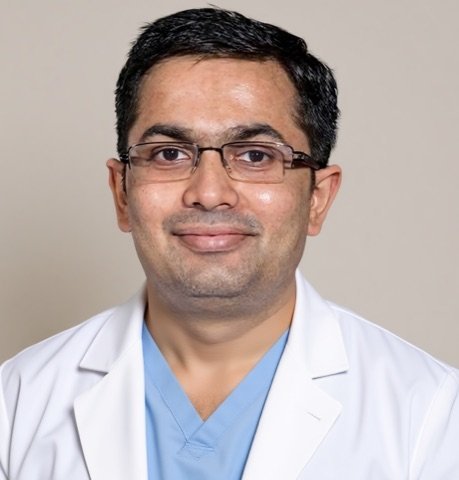
Last updated: 18 October 2026 · Written and medically reviewed by Dr Harsh Shah

Call +91 63555 64601 WhatsApp your scan or examination note

Umbilical and paraumbilical hernia: what you have

An umbilical hernia is a gap in the muscle wall at the navel. A paraumbilical hernia is a gap just above or below it. In adults both are treated the same way.

The middle of your tummy wall is a strip of tough tissue that joins the two long muscles. The navel is a natural weak point in that strip. When the pressure inside the tummy rises again and again, the weak point can stretch into a hole. Fat, and sometimes a loop of bowel, then pushes out under the skin.

Doctors use two names for this. An umbilical hernia comes through the navel ring itself. A paraumbilical hernia comes through the strip just above or below the navel. The difference matters little to you. The repair is chosen by the size of the gap, not by its name.

Common reasons for the pressure are extra weight around the waist, pregnancy, a long-standing cough, straining on the toilet, heavy lifting, and fluid in the tummy from liver disease. Many people have more than one of these. Part of the plan is to deal with them, because they also pull on a fresh repair.

Not every lump at the navel is a hernia. There is a fuller note on belly button hernia in adults.

How the size of the gap decides the repair

The width of the hole in the muscle decides the repair. A very small gap can be stitched. Most gaps need a mesh. Large gaps are usually repaired laparoscopically.

Dr Harsh Shah examines you standing and lying down. He feels the edges of the gap with a finger and checks the strip above and below for a second gap. If the edges are hard to feel, for example under a thick layer of fat, an ultrasound measures the gap and looks for other weak spots. A CT scan is needed only for large or repeat hernias.

Joint European and American hernia guidance from 2019 groups the plan into three bands. They are a guide, not a rule. Your weight, health and past operations are weighed with them.

Gap sizeUsual repairMeshCutWho it suits
Under about 1 cmOpen suture repairUsually noneOne small curved cut at the navelSlim patients with a single tiny gap
About 1 to 4 cmOpen mesh repairFlat mesh placed behind the muscleOne cut at the edge of the navel, about 3 to 4 cmMost adults with a single gap
Over about 4 cm, or many gapsLaparoscopic mesh repairLarger mesh, well past the gapThree small cuts on the side of the tummyLarger gaps, heavier patients, gaps with muscle separation, repeat hernias

The reason mesh is used for most gaps is simple. A gap closed only with stitches is under tension. Over the years the stitches can cut through, and the hernia comes back. Studies show fewer repeat hernias when a mesh is added, even for gaps of one or two centimetres. A mesh is a thin sheet of soft plastic net. Your own tissue grows into it and holds it firm.

The three repairs, step by step

All three repairs push the hernia back and close the gap. They differ in whether a mesh is added and in how the surgeon reaches the gap.

Open suture repair. A small curved cut is made in the skin fold of the navel. The bulge is freed and pushed back. The gap is closed with strong, slowly dissolving stitches. This is kept for very small gaps in people who are not overweight.

Open mesh repair. The cut is the same, sometimes a little longer. After the bulge is pushed back, a space is opened behind the muscle. A round or oval mesh is laid flat in that space so it overlaps the gap on every side. The gap is then closed over it. The navel skin is stitched back down so that it keeps its shape. Most patients go home the same day or the next morning.

Laparoscopic mesh repair. The repair is done through three small cuts on one side of the tummy, away from the navel. A camera shows the gap from the inside. The gap is first closed with stitches. A larger mesh is then laid so that it overlaps the gap by about five centimetres in every direction. Where the layers allow, Dr Harsh Shah places the mesh outside the inner lining of the tummy. Where they do not, a coated mesh made to sit next to the bowel is placed inside and fixed in position. The choice is explained before you sign consent.

The laparoscopic route has one more strength. It shows the whole midline from the inside. A second small gap that could not be felt is often found and covered by the same mesh.

Laparoscopic or open: an honest comparison

Neither route suits everyone. Open repair is quick and simple for small gaps. Laparoscopic repair suits larger gaps and heavier patients because it avoids a big wound.

Where open repair is the better fit. For a single small gap, the open repair is short and the cut is hidden in the navel. It can be done under a spinal anaesthetic if a general anaesthetic is a worry. It does not enter the tummy, so there is no risk to the bowel from the camera ports.

Where laparoscopic repair is the better fit. A large gap repaired from the front needs a large cut over the navel. In a patient carrying extra weight, that wound is more likely to get infected or collect fluid. The laparoscopic route keeps the cuts small and away from the fold of the navel. It also lets a larger mesh be placed, which matters more as the gap gets bigger.

What laparoscopic repair costs you. It needs a general anaesthetic. The fixing stitches can ache for some weeks. When the mesh sits inside the lining, there is a small risk of bowel sticking to it in later years. These are the reasons it is not used for every small hernia.

Liver cirrhosis and fluid in the tummy: a special case

With cirrhosis and fluid in the tummy, the fluid is controlled first. A hernia with thin, broken or leaking skin is repaired urgently, because waiting is then the bigger risk.

Fluid in the tummy from liver disease pushes hard on the navel. Umbilical hernias are common in this group, and they tend to grow fast. A repair done while the fluid is still building up is much more likely to fail. The wound can also leak fluid, and that can lead to infection.

So the first step is to work with your liver doctor. Water tablets, a low-salt diet and sometimes a procedure to drain the fluid come first. Once the fluid is under control and your liver tests are steady, a planned repair is often safe and worthwhile. Waiting too long has its own risks.

Some signs mean the repair cannot wait. These are skin over the lump that is thin, dark or broken, any leak of clear fluid from the navel, and a lump that becomes hard and painful. These need the hospital the same day. There is a fuller note on umbilical hernia in liver cirrhosis.

When Dr Harsh Shah advises waiting, or not operating yet

A small hernia that causes no pain can sometimes be watched. Women planning another pregnancy may wait until after it. A hernia that is stuck or painful is repaired.

A small hernia that does not hurt. Watching it is a fair choice. You are taught the warning signs and seen again. Many such hernias grow, and most people choose a repair in the end.

Another pregnancy planned. Pregnancy stretches the wall again and raises the risk that a repair fails. If the hernia is small and comfortable, the repair is often put off until the family is complete. There is a separate note on hernia during pregnancy.

Things to fix first. Smoking, an untreated cough, constipation and high sugar all weaken healing. These are sorted out before a planned repair.

Not when it is stuck. A hernia that will not go back, or one that has given you an attack of pain with vomiting, is repaired rather than watched. A belt or binder may ease the drag, but it does not close the gap. See the note on whether a hernia belt helps.

What patients say

Your patient journey: five steps

  1. Book your consultation. Call or send a WhatsApp message to book a visit. Bring any ultrasound or CT report, your list of medicines, and the details of any past operation on your tummy.
  2. Tests and treatment plan. The gap is measured by examination and, if needed, by ultrasound. Blood tests, a heart tracing and a chest check are done to make sure the anaesthetic is safe. You leave knowing which repair is planned, whether a mesh will be used, and why.
  3. The surgery. The repair is done at Dr. Jivraj Mehta Hospital, Vasna, Ahmedabad. An open repair takes about an hour. A laparoscopic repair takes about one to two hours.
  4. Short hospital stay. Most patients go home the same day or the next morning. You walk within a few hours. Patients with liver disease or a large repair may stay a little longer.
  5. Follow-up and full healing. You are seen at about one week to check the wound and again at about six weeks. Desk work is usually possible within one to two weeks. Heavy lifting is built up slowly from about six weeks.

The day of surgery, hour by hour

This is how a planned repair usually runs at Dr. Jivraj Mehta Hospital, Vasna, Ahmedabad. The times are a guide.

  1. Early morning. You arrive having had nothing to eat from midnight. Papers and insurance steps are completed. The anaesthetist sees you and the hernia is marked.
  2. The operation. The repair is done under general or spinal anaesthesia, as planned. Local numbing medicine is put into the wound so that you wake up more comfortable.
  3. Two to four hours later. You sit up, drink water and then eat a light meal. You walk to the toilet with help.
  4. Going home. The wound is checked and your pain is reviewed. You get tablets, a list of warning signs, the date of your review and a phone number that is answered. Someone should take you home and stay with you that night.

Cost, insurance and admission

The cost depends on the repair chosen, the type and size of mesh, the length of stay and your health. Most health insurance policies cover umbilical hernia repair.

No single figure fits everyone, so none is quoted here. These are the things that move the estimate. A laparoscopic repair costs more than an open one. A coated mesh made to sit next to the bowel costs more than a plain mesh. A larger gap needs a larger mesh. Diabetes, heart disease or liver disease can mean extra tests and a longer stay. The room category you choose also changes the bill.

Umbilical hernia repair is covered by most health insurance policies. Cashless treatment is available at Dr. Jivraj Mehta Hospital, Vasna, Ahmedabad with most insurers. Pre-approval is sought with the examination findings and any scan report attached. Our coordinator handles the forms and tells you before admission what has been approved. Bring your insurance card, a photo ID, your policy papers and all your reports. There is a fuller note on hernia surgery and your insurance claim, and a page on what hernia surgery costs in Ahmedabad.

Cashless at Dr. Jivraj Mehta Hospital

Umbilical hernia repair with mesh is on Dr. Jivraj Mehta Hospital’s PPN package list, so it is cashless if your policy is with one of the four public-sector insurers: New India Assurance, Oriental Insurance, United India Insurance or National Insurance (GIPSA PPN). The hospital’s TPA desk handles the pre-authorisation. Bring your policy card, photo ID and reports. If you are insured elsewhere, insurance is still accepted and the desk applies for cashless approval under your policy.

Recovery and what can go wrong

Most people walk the same day and return to desk work within two weeks. Fluid under the wound is the most common problem. It usually settles without any treatment.

The usual course. The navel is sore for a few days. Bruising is common. A firm swelling under the wound in the first weeks is usually a collection of fluid called a seroma. It settles on its own in most people and is left alone. After a laparoscopic repair, the fixing stitches on the side of the tummy can ache for a few weeks. Gas pain in the shoulder for a day or two is also common.

Problems to know about. The wound can get infected, more often in people who smoke, have diabetes or carry extra weight. Most infections settle with dressings and tablets. Infection of the mesh is rare, but it may need the mesh to be removed. The skin of the navel can lose some blood supply after a large open repair. During a laparoscopic repair the bowel can be injured. This is rare, and it is repaired at the same sitting.

The hernia coming back. A mesh repair of the right size comes back in only a small share of people. Gaps closed only with stitches come back more often, which is why they are kept for tiny gaps. Smoking, extra weight, a constant cough and fluid from liver disease all raise the risk. For getting back to activity, read about lifting and the gym after hernia repair and about hernia surgery recovery time.

Questions patients ask

Will my umbilical hernia go away without surgery?

No. In babies, a navel hernia often closes by itself. In adults it does not. Tablets, exercise and belts cannot close the gap. A small hernia that does not hurt can be watched, but only surgery repairs it. See the note on whether medicine can treat a hernia.

Do I need a mesh for a small umbilical hernia?

For a gap under about one centimetre in a slim person, stitches alone may be enough. For most other gaps a mesh lowers the chance of the hernia coming back. The with-or-without-mesh note explains the trade-off.

Will I still have a navel after the operation?

Yes. In an open repair the cut follows the curve of the navel, and the navel skin is stitched back down so it keeps its dip. In a laparoscopic repair the cuts are on the side of the tummy and the navel is not cut at all.

How long will I be off work?

Most people go back to desk work in one to two weeks. Work that involves heavy lifting usually needs four to six weeks. Your exact timeline is given at the follow-up visit.

I have liver cirrhosis. Can my hernia be repaired?

Often yes, once the fluid in your tummy is controlled and your liver doctor agrees. The repair is urgent if the skin over the lump is thin or broken, or if fluid leaks from the navel.

I am planning another pregnancy. Should I wait?

If the hernia is small and comfortable, waiting until your family is complete is often sensible. Pregnancy stretches the wall again and can undo a repair. If the hernia is painful or growing, it is repaired sooner.

Which warning signs mean I should go to hospital?

A lump that becomes hard and painful and will not go back, especially with vomiting or a swollen tummy. This can mean bowel is trapped. Go to the hospital at once. Read more on warning signs of a trapped hernia.

Is the operation done as day care?

An open repair of a small or medium gap is often done as day care. A laparoscopic repair, or a repair in someone with other illnesses, usually needs one night. See the note on day-care hernia surgery.

Is umbilical hernia repair cashless at Dr. Jivraj Mehta Hospital?

Yes, for policyholders of New India Assurance, Oriental Insurance, United India Insurance and National Insurance, because it is a PPN package operation. The hospital's TPA desk handles pre-authorisation. With other insurers, the desk applies for cashless approval under your policy.

Where Dr Harsh Shah sees and operates

Dr Harsh Shah — Dr. Jivraj Mehta Hospital, Vasna, Ahmedabad
Plot No. 1 A, Dr. Jivraj Mehta Hospital, Dr Jivraj Mehta Marg, Vasna, Ahmedabad 380007
Directions to Dr. Jivraj Mehta Hospital, Vasna · +91 63555 64601

Rate this page

Get health updates from Dr Harsh Shah on WhatsApp

Swasth Parivar: every week, practical advice on recovery, diet and warning signs. No advertising. Stop any time.

Your number is used for these updates and for the clinic to reach you. It is never sold or passed on. To stop, reply STOP on WhatsApp.

Hernia Surgery — Dr Harsh Shah
Privacy Overview

This website uses cookies so that we can provide you with the best user experience possible. Cookie information is stored in your browser and performs functions such as recognising you when you return to our website and helping our team to understand which sections of the website you find most interesting and useful.