Femoral Hernia Surgery — Planned Repair and Emergency Care

Centre in Ahmedabad · Dr. Jivraj Mehta Hospital, Vasna, Ahmedabad

A femoral hernia is a small lump just below the groin crease, at the top of the thigh. It is often soft, often causes no pain, and is easy to mistake for a swollen gland. Yet it is the groin hernia most likely to trap a loop of bowel. That is why it is repaired soon after it is found, not watched. This page explains why, how Dr Harsh Shah repairs it by keyhole or open surgery, and what to do if the lump suddenly becomes hard and sore.

Last updated: 18 Oct 2026 · Written and reviewed by Dr Harsh Shah

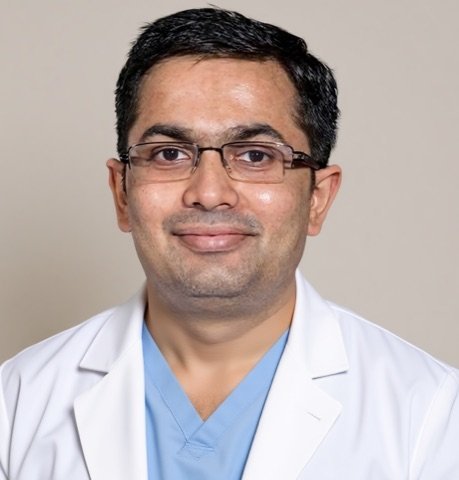
Dr Harsh Shah · groin hernia repair at Dr. Jivraj Mehta Hospital, Vasna, Ahmedabad. Trained at Maulana Azad Medical College and GB Pant Hospital, Delhi. Holds the MCh and DrNB in surgical gastroenterology, with 18 years of experience in abdominal surgery, including emergency surgery for trapped bowel. Femoral hernias are repaired by keyhole or open surgery, chosen for the patient and the situation.
Call +91 63555 64601 WhatsApp your scan or examination note

In short

A femoral hernia pushes through a narrow gap below the groin crease. Because the gap is tight, bowel can get stuck. It should be repaired soon after diagnosis.

Most femoral hernias can be repaired as a planned operation, by keyhole surgery through three small cuts. A mesh covers the gap from behind. Many people go home the same day or the next. When the hernia is already stuck, the repair becomes urgent. It is then done by keyhole or open surgery, depending on the state of the bowel and your general health.

Dr Harsh Shah sees planned cases and operates at Dr. Jivraj Mehta Hospital, Vasna, Ahmedabad, which has an emergency department open day and night.

What a femoral hernia is, and who gets it

The femoral canal is a small space beside the large vein to the leg. A femoral hernia is fat or bowel pushing down through this canal into the upper thigh.

The femoral canal lies just below the groin ligament. It is narrow, and its edges are firm. That firm, tight neck is the whole problem. A loop of bowel can slip in, swell, and then be unable to slip back.

  • Who gets it: women more than men, mostly in later life. Pregnancy, weight loss in older age, a chronic cough and straining all play a part.
  • How it feels: a small, round lump in the upper inner thigh, just below the crease. It may not go back when you lie down. Many people feel no pain at all.
  • Why it is missed: it is small, it sits where lymph glands also sit, and in a heavier person it can be hard to feel.

A lump above the groin crease is more often an inguinal hernia. The two can be hard to tell apart by touch. An ultrasound settles the question when the examination is not clear. There is a short guide on whether a groin lump is a hernia.

Why a femoral hernia is repaired sooner

Of all groin hernias, femoral hernias are the most likely to trap bowel. For this reason, hernia guidelines advise repair soon after diagnosis rather than watching.

With an inguinal hernia that causes no symptoms, a man may safely wait and watch. That advice does not carry over to a femoral hernia. Published studies show that a large share of femoral hernias come to an emergency within months to a couple of years of being noticed. Many first come to light only when they get stuck.

An emergency repair is a bigger operation than a planned one. If the trapped bowel has lost its blood supply, a piece of it may need to be removed. The hospital stay is longer, and the risks are higher, especially in older people. A planned repair avoids most of this. So when Dr Harsh Shah finds a femoral hernia, he advises a date for surgery rather than a date for review. The full reasoning is set out in the guide on why a femoral hernia is repaired sooner.

Emergency presentation — signs you must not wait on

Go to hospital at once if the lump becomes hard, tender and will not go back, especially with vomiting, a swollen belly, or no passing of wind or stool.

  1. A lump that has turned hard and painful. It may have been soft before. It now hurts to touch and will not go back.
  2. Vomiting and a swollen belly. These suggest the bowel is blocked.
  3. No passing of wind or stool. Another sign of blocked bowel.
  4. Redness over the lump, or fever. These can mean the trapped bowel is losing its blood supply.

Do not try to force a hard, painful lump back in. Do not wait for an OPD appointment. Come to the emergency department at Dr. Jivraj Mehta Hospital, Vasna, Ahmedabad, or the nearest hospital, and call +91 63555 64601 on the way. Time matters here: bowel that is freed early usually recovers. There is more on strangulated hernia warning signs.

How a femoral hernia is repaired

The gap can be closed from behind by keyhole surgery, or from the front by open surgery below or above the groin crease. Each approach suits a different situation.

Laparoscopic repair (TEP or TAPP). Three small cuts near the navel. The surgeon works in the space behind the muscle. The hernia is drawn back, and a flat mesh is laid over the femoral gap and the nearby inguinal area together. This matters, because women with a femoral hernia often have a hidden weakness next to it. The keyhole view also lets the surgeon check the other side. For a planned repair, international guidance favours this approach where the skill is available.

Open low approach. A short cut is made just below the groin crease, right over the lump. The sac is freed and the gap is closed with a small mesh plug or with stitches. It can be done under local or spinal anaesthesia. It suits frail patients and those who should avoid general anaesthesia. Its limit is that it gives little room to deal with bowel.

Open high approach. The cut is made above the groin crease. The surgeon can open the abdomen lining here, look at the trapped bowel, and remove a damaged piece if needed. This is the usual open choice in an emergency when the bowel may be harmed.

Mesh or stitches. A mesh gives the strongest repair in a clean field. If bowel has been opened or removed, a permanent mesh may be avoided to lower the risk of infection. The gap is then closed with stitches. This decision is made in theatre and explained to you afterwards. See which mesh is used in hernia repair.

Laparoscopic or open — an honest comparison

PointLaparoscopic (TEP / TAPP)Open low approachOpen high approach
Where the cut isThree small cuts near the navelBelow the groin creaseAbove the groin crease
AnaesthesiaGeneralLocal, spinal or generalSpinal or general
Checks the other sideYesNoNo
Covers the nearby inguinal areaYes, with one meshNoPartly
Can deal with damaged bowelYes, in suitable casesLimitedYes
Early recoveryUsually quickerQuick, small woundSlower
Who it suitsMost planned repairs in fit adultsFrail patients, local anaesthesiaEmergencies with possible bowel harm

None of these is right for everyone. A fit woman with a soft femoral hernia found on a scan usually does well with keyhole repair. An elderly man with heart disease may be safer with an open low repair under local anaesthesia. A patient who arrives vomiting with a hard lump needs whichever approach lets the surgeon see and save the bowel. There is a separate page on open hernia repair in Ahmedabad.

What patients say

Your patient journey — five steps

  1. Book your consultation. Come to Dr. Jivraj Mehta Hospital with any scan and your medicine list. The groin and upper thigh are checked on both sides, standing and lying down.
  2. Tests and treatment plan. An ultrasound is often used, because a femoral hernia is small and easy to confuse with a gland. Blood tests, an ECG and an anaesthesia check follow. A surgery date is usually set within days to weeks, not months.
  3. The surgery. At Dr. Jivraj Mehta Hospital, Vasna, Ahmedabad. A planned keyhole repair usually takes about an hour. An open low repair under local anaesthesia is often shorter.
  4. Short hospital stay. After a planned repair, most people go home the same evening or the next morning. After an emergency with bowel removal, the stay is several days.
  5. Follow-up and full healing. A wound check at about one week, and a review at around six weeks. Normal activity returns over two to four weeks, heavy lifting from about six weeks.

Cost, insurance and admission

Femoral hernia repair is covered by most health insurance policies. Cashless admission is available at Dr. Jivraj Mehta Hospital, Vasna, Ahmedabad, for planned and emergency surgery.

We do not quote a single figure, because the cost depends on a few real factors:

  • Planned or emergency surgery.
  • Keyhole or open repair, and the type of anaesthesia.
  • Whether a mesh is used, and its type.
  • Whether bowel needed to be removed, and the length of stay.
  • Room category and any other health problems needing care.

For a planned repair, our coordinator sends the pre-authorisation with the examination and scan findings, and you learn what is approved before admission. In an emergency, admission is not delayed for paperwork. The insurer is informed within the time your policy allows. Bring your insurance card, photo ID and earlier reports. See hernia surgery and your insurance claim and what shapes hernia surgery cost in Ahmedabad.

Recovery and risks, stated plainly

After a planned repair, most people walk the same day and return to light work within one to two weeks. After an emergency, recovery takes longer.

The usual course. Soreness for a few days. Some bruising in the groin or upper thigh. A soft swelling where the lump was, which is often a small fluid pocket called a seroma. It settles on its own over a few weeks.

Problems to know about. Bleeding, because the repair sits next to the large vein to the leg. Infection, more likely after an emergency. Difficulty passing urine for a few hours. Long-lasting groin ache in a small number of people. Rarely, injury to the vein or to the bladder, which is repaired at the same sitting. The hernia can come back, though this is uncommon after a well-placed mesh.

After an emergency. If bowel was removed, you will stay several days. You eat slowly at first, and you will be seen more often in the weeks after. See hernia surgery recovery, week by week.

Questions patients ask

Can a femoral hernia be left alone if it does not hurt?

Usually not. Femoral hernias are more likely than other groin hernias to trap bowel, even when they cause no pain. Guidelines advise repair soon after diagnosis, unless you are too unwell for any operation.

How do I know it is a femoral hernia and not an inguinal hernia?

A femoral hernia sits below the groin crease, at the top of the thigh. An inguinal hernia sits above it. By touch they can be hard to tell apart, so an ultrasound is often used. The keyhole repair covers both areas in any case.

Is femoral hernia surgery done by keyhole?

Most planned repairs can be. Keyhole repair also checks the other side and covers the nearby inguinal area. Open repair is used when general anaesthesia is risky, or in some emergencies.

Can it be done under local anaesthesia?

Yes, by the open low approach, in suitable patients. This is useful for frail or elderly people. See hernia surgery in elderly patients.

Will a mesh be used?

In a planned repair, yes, in most cases. If bowel has been opened during an emergency, a permanent mesh may be avoided and the gap closed with stitches to lower the risk of infection.

How long will I be in hospital?

After a planned repair, usually the same day or one night. After an emergency with bowel removal, several days.

I am pregnant and have a lump in my groin. What should I do?

See a surgeon to confirm what it is. Groin swellings in pregnancy are often not hernias. Planned surgery is usually delayed until after delivery unless the lump gets stuck. See hernia during pregnancy.

When can I go back to work?

Desk work in about one to two weeks after a planned repair. Heavy lifting from about six weeks. Longer after an emergency operation.

Where Dr Harsh Shah sees and operates

Dr Harsh Shah — Dr. Jivraj Mehta Hospital, Vasna, Ahmedabad
Plot No. 1 A, Dr. Jivraj Mehta Hospital, Dr Jivraj Mehta Marg, Vasna, Ahmedabad 380007
Directions to Dr. Jivraj Mehta Hospital, Vasna · +91 63555 64601

Rate this page

Get health updates from Dr Harsh Shah on WhatsApp

Swasth Parivar: every week, practical advice on recovery, diet and warning signs. No advertising. Stop any time.

Your number is used for these updates and for the clinic to reach you. It is never sold or passed on. To stop, reply STOP on WhatsApp.

Hernia Surgery — Dr Harsh Shah
Privacy Overview

This website uses cookies so that we can provide you with the best user experience possible. Cookie information is stored in your browser and performs functions such as recognising you when you return to our website and helping our team to understand which sections of the website you find most interesting and useful.