Open Hernia Repair — Lichtenstein, Umbilical and Sublay Mesh Repair

Centre in Ahmedabad · Dr. Jivraj Mehta Hospital, Vasna, Ahmedabad

Keyhole surgery is not the right answer for every hernia, or for every person. Some people should not have a general anaesthetic. Some hernias have come back after a keyhole repair. Some are stuck and need surgery tonight. For these, an open repair through a single cut is often the safer, simpler and wiser choice. This page explains who open repair suits, the three main open operations Dr Harsh Shah performs, and how open and keyhole repair honestly compare.

Last updated: 18 Oct 2026 · Written and reviewed by Dr Harsh Shah

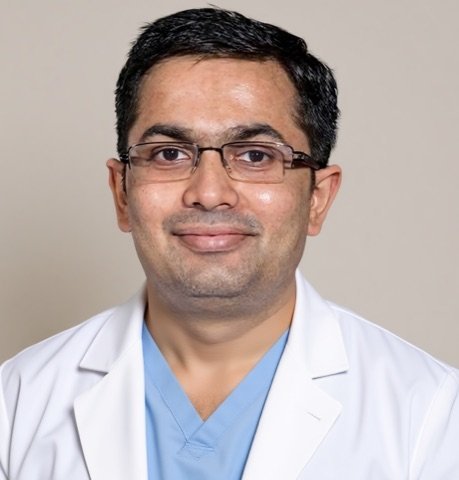
Dr Harsh Shah · groin and abdominal wall hernia repair at Dr. Jivraj Mehta Hospital, Vasna, Ahmedabad. Trained at Maulana Azad Medical College and GB Pant Hospital, Delhi. Holds the MCh and DrNB in surgical gastroenterology, with 18 years of experience in abdominal surgery. Performs both open and keyhole hernia repair, so the advice you get is about which one fits you, not about which one he offers.
Call +91 63555 64601 WhatsApp your scan or examination note

In short

Open hernia repair fixes the hernia through one cut over it, usually with a mesh. It can be done under local or spinal anaesthesia, which suits people unfit for general anaesthesia.

Open repair is the older way of fixing a hernia, but older does not mean worse. Done well, it holds as well as keyhole repair. Its main cost is a larger cut and, for groin hernias, a little more pain in the first week or two. Its main gains are flexibility of anaesthesia, a fresh layer to work in after a failed keyhole repair, and direct access in an emergency.

Dr Harsh Shah performs three main open operations: the Lichtenstein repair for groin hernias, open umbilical repair for navel hernias, and open sublay repair for larger hernias in the front of the belly and in old scars.

Who open repair suits

Open repair suits older or frail people, those unfit for general anaesthesia, emergencies with a stuck hernia, and some hernias that return after keyhole repair.

  • Older people. Age alone is not a reason to avoid keyhole surgery. But many older people have heart, lung or kidney problems, and a short open repair under local anaesthesia puts less strain on them. See hernia surgery in elderly patients.
  • People unfit for general anaesthesia. Severe lung disease, recent heart trouble or a very weak heart. Keyhole repair needs general anaesthesia and gas in the abdomen. An open groin repair does not.
  • People who prefer to stay awake. A groin or small navel hernia can be repaired under local anaesthesia with light sedation. You can talk to the team throughout.
  • Emergencies. A stuck or strangulated hernia may need the bowel to be checked and sometimes a piece removed. An open cut gives direct access, especially when the belly is swollen.
  • Return after a keyhole repair. The space behind the muscle is scarred, so the untouched front layer is used. This is a standard rule in hernia surgery.
  • Scarred lower belly. Prostate surgery, bladder surgery or pelvic radiotherapy can scar the space a keyhole groin repair needs.
  • Very small navel hernias. A small gap at the navel is quick to repair through a short cut, often as a day case.

Lichtenstein repair for groin hernias

The Lichtenstein repair closes an inguinal hernia from the front by laying a flat mesh over the floor of the groin canal, through one cut in the groin.

  1. Anaesthesia. Local with sedation, spinal, or general, chosen with the anaesthetist.
  2. The cut. About 6 to 8 cm, in the skin crease above the groin.
  3. The sac. The hernia sac is freed and pushed back, or tied off. The cord to the testis and the three groin nerves are found and kept safe.
  4. The mesh. A lightweight mesh is shaped and stitched over the floor of the canal, with a slit to let the cord pass. It is fixed without tension, so the tissues are not pulled together.
  5. Closing. The layers are closed with dissolving stitches. Most people go home the same day or the next.

Care with the nerves is the most important step. Long-lasting groin pain after open repair is usually nerve-related. Seeing each nerve and keeping it clear of the mesh and stitches lowers that risk. For the keyhole alternative, see laparoscopic inguinal hernia surgery. For a femoral hernia, the open repair is done through a cut below or above the groin crease instead.

Open umbilical hernia repair

An umbilical hernia is a gap at the navel. Small gaps are closed with stitches, and larger gaps are reinforced with a mesh placed behind the muscle.

A small curved cut is made at the edge of the navel, so the scar hides in its fold. The sac is freed and pushed back. What follows depends on the size of the gap.

  • Very small gap, about 1 cm or less: closed with strong stitches. A mesh adds little here.
  • Gap of 1 cm or more: a flat mesh is placed in the layer behind the muscle, and the gap is closed over it. Hernia guidelines advise mesh at this size, because stitches alone come back more often.
  • Larger gaps, or a gap with a wide split of the muscles above it, may be better repaired by keyhole surgery or by open sublay repair.

This repair can often be done under spinal or local anaesthesia. People with liver disease and fluid in the belly need special care before any navel repair. See umbilical hernia in liver cirrhosis. There is a full page on umbilical hernia surgery in Ahmedabad.

Open sublay repair for front-wall and scar hernias

Sublay repair places a large mesh behind the long front muscles of the belly, then closes the muscles over it. It suits larger hernias in old scars.

Scar hernias, also called incisional hernias, form in the cut of an earlier operation. Some front-wall hernias are wide. For these, the open sublay repair, also called the Rives-Stoppa repair, is a well-tested operation.

  1. The old scar is opened and the hernia sac is freed. Bowel stuck to the sac is gently separated.
  2. The space behind the long front muscles is opened on each side.
  3. A large mesh is laid in this space, well beyond the edges of the gap. It sits away from the bowel and away from the skin.
  4. The muscle layer is closed over the mesh, rebuilding the middle line of the belly.
  5. Drains may be left for a day or two, and the skin is closed.

Because the mesh lies between muscle layers, it is well protected. Infection of the mesh is uncommon, and the repair is strong. Very large or complex hernias may need more steps, such as release of the side muscles. These are covered on the complex and recurrent hernia surgery page and the ventral and incisional hernia surgery page.

Open or keyhole — an honest comparison

PointOpen repairLaparoscopic repair
CutOne cut over the herniaThree small cuts, away from the hernia
AnaesthesiaLocal, spinal or generalGeneral only
Pain in the first weekUsually a little moreUsually a little less
Return to desk workAbout one to two weeksAbout one week
Wound infectionSomewhat more commonLess common
Hernia coming backLow, similar in trained handsLow, similar in trained hands
Both groins at onceTwo cutsSame three cuts
After a failed keyhole repairPreferred, fresh layerUsually avoided
Emergency with stuck bowelDirect access, often usedPossible in suitable cases
Who it suitsFrail, unfit for general anaesthesia, some recurrencesMost fit adults, both sides, women

The honest summary: for a fit adult with a first groin hernia, keyhole repair usually gives a quicker, more comfortable recovery. For many others, open repair is the safer path. Neither is a lesser operation. Dr Harsh Shah explains which applies to you, and why, at the consultation.

What patients say

Your patient journey — five steps

  1. Book your consultation. Come to Dr. Jivraj Mehta Hospital with your scans, your medicine list and notes from earlier operations. Bring the note from any previous hernia repair if you have it.
  2. Tests and treatment plan. Blood tests, an ECG and a check by the anaesthetist. For scar hernias, a CT scan maps the gap. You leave knowing which repair is planned, which anaesthesia, and why.
  3. The surgery. At Dr. Jivraj Mehta Hospital, Vasna, Ahmedabad. A Lichtenstein or umbilical repair takes about an hour. A sublay repair takes longer, depending on the size of the hernia.
  4. Short hospital stay. Groin and small navel repairs: usually home the same day or the next. Sublay repairs: usually two to four days.
  5. Follow-up and full healing. A wound check at about one week, and a review at around six weeks. Heavy lifting returns from about six weeks for groin repairs, later for large scar hernias.

Cost, insurance and admission

Open hernia repair is covered by most health insurance policies. Cashless admission is available at Dr. Jivraj Mehta Hospital, Vasna, Ahmedabad, after pre-authorisation from your insurer.

We do not quote a fixed figure. The cost is shaped by these factors:

  • The type of hernia and the operation needed.
  • Whether a mesh is used, and its size.
  • Local, spinal or general anaesthesia.
  • Planned or emergency surgery, and the length of stay.
  • Room category and other health problems that need care.

Our coordinator sends the pre-authorisation with your findings, and tells you what is approved before admission. Bring your insurance card, photo ID and earlier reports. See hernia surgery and your insurance claim and what shapes hernia surgery cost in Ahmedabad.

Recovery and risks, stated plainly

After an open groin or navel repair, most people walk the same day and return to desk work in one to two weeks. Larger repairs take longer.

The usual course. Soreness at the cut for one to two weeks, eased by tablets. Some bruising, which fades. A firm ridge under the scar as it heals, which softens over months. A soft swelling under the wound may be a seroma, a small fluid pocket that usually settles.

Problems to know about. Wound infection, which is more common than after keyhole repair and is usually treated with dressings and antibiotics. Bleeding or a collection of blood. Difficulty passing urine for a few hours after spinal anaesthesia. Swelling of the testis after groin repair in men. After sublay repair, fluid under the wound and a longer recovery.

Long-lasting groin pain affects a small number of people after any groin repair. It is the risk to weigh most for open groin surgery. Careful handling of the nerves lowers it. See groin pain after hernia surgery.

The hernia coming back is uncommon after a well-placed mesh. Smoking, obesity, constipation and lifting too soon raise the risk. See recurrent hernia after a previous repair.

Questions patients ask

Is open hernia repair outdated?

No. It holds as well as keyhole repair when done well. It remains the right choice for people unfit for general anaesthesia, for many emergencies, and for hernias that return after keyhole repair.

Can I stay awake during open hernia surgery?

Often, yes. Groin and small navel hernias can be repaired under local anaesthesia with light sedation, or under spinal anaesthesia. See anaesthesia for hernia surgery.

Will a mesh be used in open repair?

For most adult groin hernias, navel gaps of 1 cm or more, and scar hernias, yes. Very small navel gaps can be closed with stitches alone. In a contaminated emergency field, a permanent mesh may be avoided.

My hernia came back after a keyhole repair. What now?

An open repair from the front is usually advised, because it works in a fresh layer that has not been touched. The earlier operation note helps plan it.

How big will the scar be?

About 6 to 8 cm for a groin repair, in the skin crease. A small curve at the navel for an umbilical repair. A scar hernia is usually repaired through the old scar. See hernia surgery scars.

How long is the hospital stay?

Groin and small navel repairs: usually the same day or one night. Sublay repairs for larger hernias: usually two to four days.

When can I lift heavy things again?

For most groin and navel repairs, from about six weeks, building up slowly. For large scar hernias, your surgeon will advise a longer wait. See lifting and gym after hernia repair.

Is open repair safe for an 80-year-old?

For many older people, an open repair under local anaesthesia is the gentlest option. Fitness is checked first, and any heart, lung or kidney problems are settled before surgery.

Where Dr Harsh Shah sees and operates

Dr Harsh Shah — Dr. Jivraj Mehta Hospital, Vasna, Ahmedabad
Plot No. 1 A, Dr. Jivraj Mehta Hospital, Dr Jivraj Mehta Marg, Vasna, Ahmedabad 380007
Directions to Dr. Jivraj Mehta Hospital, Vasna · +91 63555 64601

Rate this page

Get health updates from Dr Harsh Shah on WhatsApp

Swasth Parivar: every week, practical advice on recovery, diet and warning signs. No advertising. Stop any time.

Your number is used for these updates and for the clinic to reach you. It is never sold or passed on. To stop, reply STOP on WhatsApp.

Hernia Surgery — Dr Harsh Shah
Privacy Overview

This website uses cookies so that we can provide you with the best user experience possible. Cookie information is stored in your browser and performs functions such as recognising you when you return to our website and helping our team to understand which sections of the website you find most interesting and useful.